
NEC Article 500 vs. NEC Article 505: Which Classification System Applies?
The United States uses two parallel systems for classifying hazardous locations: the traditional Class/Division system under NEC Article 500, and the Zone-based system under NEC Article 505. Both systems are valid under the National Electrical Code, and both are in use at US industrial facilities today.
Understanding the difference matters when you’re specifying or procuring explosion-proof equipment.
🛠 Free tools:
- Determine a classification: Use our Hazardous Location Classification Wizard if you don’t yet know your facility’s Class/Division/Group.
- Translate between systems: Use our NEC 500 ↔ Zone Converter to translate any classification between the US (NEC 500) and international (NEC 505 / IEC / ATEX) systems.
The Two Systems at a Glance
| NEC Article 500 (Class/Division) | NEC Article 505 (Zone) | |
|---|---|---|
| Origin | Traditional US system | Adapted from IEC/European ATEX system |
| Primary use | Most existing US industrial facilities | Newer installations, facilities with international connections |
| Hazard categories | Class 1 (gas/vapor), Class 2 (dust), Class 3 (fiber) | Zone 0/1/2 (gas), Zone 20/21/22 (dust) |
| Groups | A, B, C, D (Class 1); E, F, G (Class 2) | IIC, IIB, IIA (gas); IIIC, IIIB, IIIA (dust) |
| Equipment marking | ”Class I, Division 2, Group D" | "Zone 2, Group IIA” |
NEC Article 500 — Class/Division
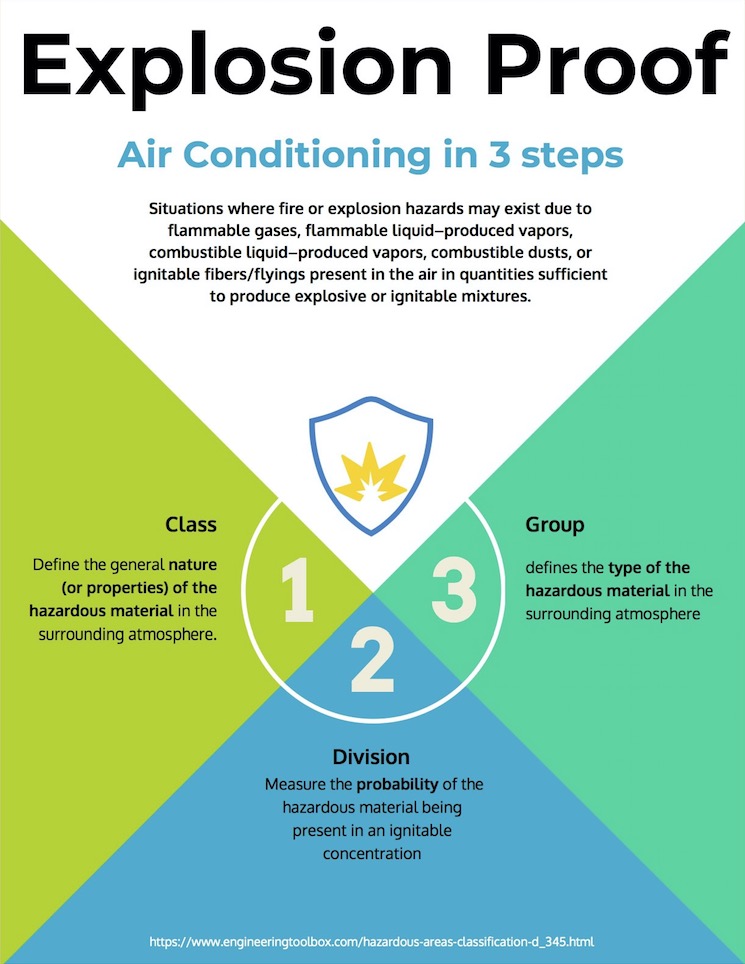
The Class/Division system is the original US hazardous location classification framework. It divides hazardous locations into:
- Classes based on the type of hazardous material (gas/vapor, dust, or fiber)
- Divisions based on likelihood of the hazard being present (normal conditions vs. abnormal conditions)
- Groups based on the specific material’s ignition characteristics
The vast majority of existing US oil and gas, chemical, and industrial facilities are classified under Article 500. If your facility was built or designed primarily for US operations and has been operating for more than 10-15 years, there’s a high probability it’s classified under Article 500.
The equipment you need: Equipment marked “Class I, Division 2, Group D” — or similar Article 500 notation.
NEC Article 505 — Zone Classification
Article 505 was introduced into the NEC to align with the IEC (International Electrotechnical Commission) Zone system used in Europe and most of the rest of the world. The Zone system divides flammable gas/vapor hazards into three zones:
- Zone 0 — Hazardous atmosphere present continuously or for long periods (equivalent to the most hazardous Division 1 scenarios)
- Zone 1 — Hazardous atmosphere likely to occur in normal operation (most of Division 1)
- Zone 2 — Hazardous atmosphere not likely in normal operation but possible (equivalent to Division 2)
For dust, the equivalent zones are 20, 21, and 22.
The equipment you need: Equipment marked “Zone 2, Group IIA” — or similar Article 505 notation.
Can You Mix Equipment From Both Systems?
Sometimes — but carefully. The NEC allows Article 505 (Zone) equipment to be used in Article 500 (Class/Division) classified areas under certain conditions, and vice versa. The equivalencies are:
| Article 500 | Article 505 |
|---|---|
| Class I, Division 1 | Zone 0 or Zone 1 |
| Class I, Division 2 | Zone 2 |
| Group A | Group IIC |
| Group B | Group IIC |
| Group C | Group IIB |
| Group D | Group IIA |
The practical implication: If your facility’s HAC drawings call out Article 500 classifications, you need Article 500-rated equipment — or equipment with verified equivalency. Don’t assume Zone-rated equipment meets your Class/Division requirements without checking.
Need to translate a specific classification? Use our interactive NEC 500 ↔ Zone Converter — it surfaces the edge cases (like Division 1 mapping to either Zone 0 or Zone 1, and IEC Group IIC covering both US Groups A and B) that the simple table above doesn’t show.
ATEX: The European System
ATEX (ATmosphères EXplosibles) is the European Union’s framework for equipment used in explosive atmospheres. ATEX-certified equipment carries the ⑇ marking and meets the IEC Zone-based classification requirements.
ATEX equipment is not automatically equivalent to US NEC-rated equipment, even for the same hazard type. The certification processes, testing standards, and labeling systems are different. US facilities should not substitute ATEX equipment for NEC-rated equipment without engineering review.
If you have international customers or projects requiring ATEX documentation, call us — we can discuss what’s involved on a case-by-case basis.
Which System Does Your Facility Use?
Check your area classification drawings. The HAC drawing will reference the applicable NEC article and show the Class/Division/Group or Zone/Group classification for each area.
If your drawings reference “Class I, Division 2, Group D” — you’re on Article 500. If they reference “Zone 2, IIA” — you’re on Article 505.
When in doubt, your facility electrical engineer can confirm which system was used in the original design.
What This Means for Your Quote
When you call us for a quote, let us know whether your facility classification is expressed in Class/Division (Article 500) or Zone (Article 505) terms. Both systems are ones we work with — the group equivalencies above guide the equipment specification either way.
Call (844) 925-5668 — we’ll make sure the equipment we quote is right for your system.
Related Pages
- Hazardous Location Classification Wizard — free interactive tool to determine your classification
- NEC 500 ↔ Zone Classification Converter — free interactive tool to translate classifications between systems
- What Is an Explosion Proof Air Conditioner? — complete guide
- Class 1, Division 2 Explained — the most common US classification
- Class 1, Division 1 Explained — continuously hazardous gas/vapor areas
- Class 2, Division 1 Explained — combustible dust environments
- Class 2, Division 2 Explained — dust accumulation environments
- Class 3, Division 1 Explained — ignitable fibers and flyings
- Explosion Proof Mini Splits — affordable cooling for classified spaces
- Explosion Proof Bard Air Conditioners — wall-mount units
- How to Choose — buyer’s guide
- Phenicon Coating — industrial-grade corrosion protection for any classification
- Custom Explosion Proof Air Conditioners — specialty builds for complex applications
- FAQ